San Clemente Rail: 700,000 Cubic Yards of Sand Set to Save the Line
The California Coastal Commission approved a permit that allows for the largest sand replenishment in the area's history, aiming to protect a railway that has closed for 12 months since 2021.
By Harper Foster ·
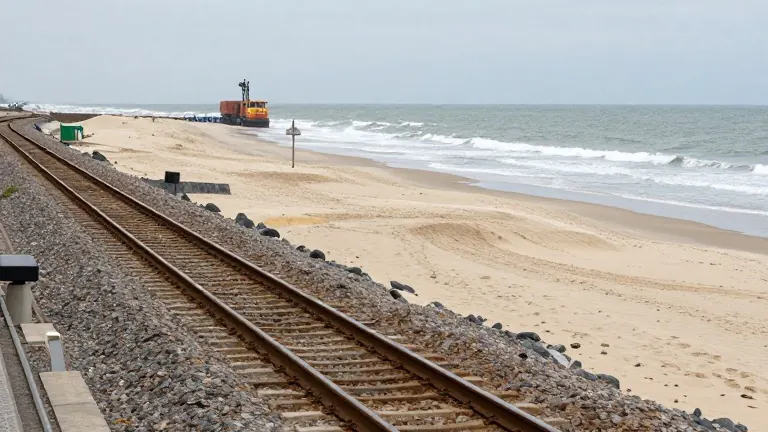
Nearly 700,000 cubic yards of sand are slated to be placed on the beaches of San Clemente to protect a railway line that has faced repeated closures. The California Coastal Commission approved an extensive permit on Thursday that allows this major shoreline work to proceed.
The rail line, which has operated since 1888, runs along a four-mile stretch of coast that has been vulnerable to rising seas and harsh waves. Orange County Supervisor Katrina Foley described the project as the first step toward resolving a half century of inaction. She noted that the county previously focused on hardening the beach with seawalls and rock piles, which she said can worsen erosion over time.
The permit balances emergency repairs with long-term plans. It includes the construction of a 1,200-foot seawall along the rail line. It also requires the Orange County Transportation Authority to manage and eventually remove large rock piles known as riprap. These piles were added under emergency permits when recent storms undermined the tracks.
Foley stated that $300 million in state and federal funding is already secured for the project. The sand replenishment will use about a third of those funds. Work could begin as soon as January.
The need for intervention is clear in the recent data. OCTA officials reported that the railway has been cumulatively closed for 12 months since 2021 due to erosion and bluff failures. The Coastal Commission processed 15 track stabilization projects during that same period, including 10 emergency permits. Closures occurred last month due to high tides and in September following a strong Pacific storm.
Local environmental groups expressed concern that the agreement did not do enough to protect the coastline. A letter signed by the Surfrider Foundation and other organizations asked the commission to require a 50-foot sandy beach seaward of the railway. Commission staff called that benchmark too strict to enforce without more data on how the new sand will settle.
Kate Huckelbridge, executive director of the Coastal Commission, said the situation is dire and that the new permit will mandate better future planning. The permit requires railway operators to monitor the sand replenishment for five years. It also mandates a study on the long-term future of the line, including examining how and where the imperiled railway could be relocated.