Pope Leo XIV addresses 650,000 in Córdoba after record turnout in Buenos Aires
The visit marks the first papal trip to Argentina in nearly four decades and has intensified political debates over austerity and historical memory.
By Lorenzo Marshall ·
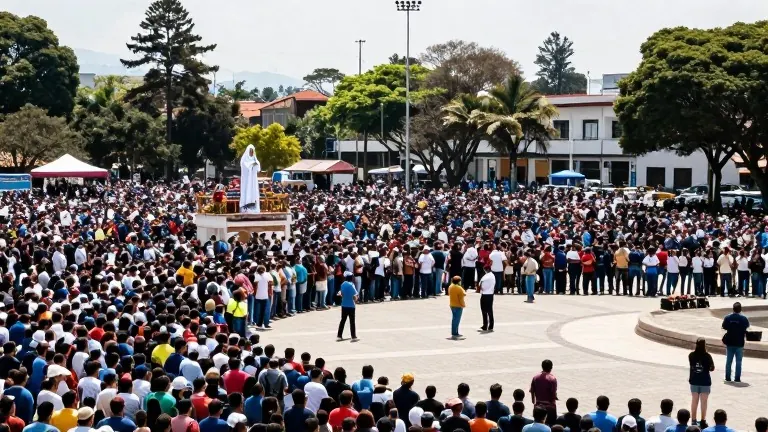
Pope Leo XIV led a Mass for an estimated 650,000 attendees in Córdoba on Tuesday. The gathering occurred one day after a crowd of approximately 2.5 million filled the capital. This makes the current visit the most attended papal tour in the country in nearly 40 years. The central location of Córdoba was selected specifically to accommodate faithful traveling from across the nation.
During the service, Leo described the region as a land of saints. He pointed to local figures like St. José Gabriel del Rosario Brochero and Mama Antula. Both were canonized by his predecessor, Pope Francis. Leo told the crowd that they were called to holiness. He noted that these figures had completed their earthly mission and left a radiant example for the faithful to follow.
The site of the liturgy carried historical weight. It is the grounds of the Argentine Aircraft Factory. This plant built the attack planes used by the military in late 1975 to strike leftist guerrillas. That campaign preceded the state terror of the 1976 to 1983 dictatorship. Human rights groups estimate that around 30,000 people were killed or disappeared during that period.
Following the Mass, Leo met privately with 20 individuals chosen by the local archbishop. Among them was Alba Camargo, 64. Her father, stepmother, aunt, and uncle all disappeared during the military rule. Camargo told the pope that she represented relatives still searching for remains at La Perla. She handed him a folder containing photos of excavations and the names of identified victims. Camargo said the pope took her hand and blessed the Franciscan crosses she had brought.
Camargo described the meeting as a gesture acknowledging the victims. She expressed hope that the visit would bring change. This hope is set against a backdrop of President Javier Milei’s government reducing funding for memorial sites. The administration has also promoted a revisionist view that frames military actions as wartime excesses rather than state crimes. Camargo said the meeting was powerful because the pope listened closely from a distance of 15 centimeters.
Political reactions to the visit have already begun to shape the national agenda. Four senators from Milei’s party started preparing to advance a stalled bill banning online gambling ads. Milei has opposed this measure, while the church supports it as a way to protect children. Foreign Minister Pablo Quirno defended the administration’s record against critics. He acknowledged on Argentine television that the pope’s remarks exposed national shortcomings. Quirno stated that the message challenges the entire political class to address what the society lacks.
Local leadership also engaged with the visit’s themes. Cardinal Ángel Rossi, the host in Córdoba, is a known critic of Milei’s policies. He has previously called cuts to aid for people with disabilities and retirees an act of state sadism. Córdoba governor Martín Llaryora posted on social media that the pope’s message of peace and fraternity challenged a divided country. The visit has thus become a focal point for discussions on both faith and political direction.
Leo’s comments in Buenos Aires on Sunday referenced Argentina’s history of gratitude and painful memories. He said each generation must discern what to preserve and confront past injustices. These remarks have been interpreted as a nod to the dictatorship era. The current visit continues to generate economic and political activity as the country processes the scale of the turnout and the specific social calls made by the pontiff.