Bennett signals optimism as Israeli unity government talks press on
B'Yachad leader Naftali Bennett said he was very optimistic about forming a unity government as negotiations between the blocs of Benjamin Netanyahu and Gadi Eisenkot continued on Tuesday.
By Harper Foster ·
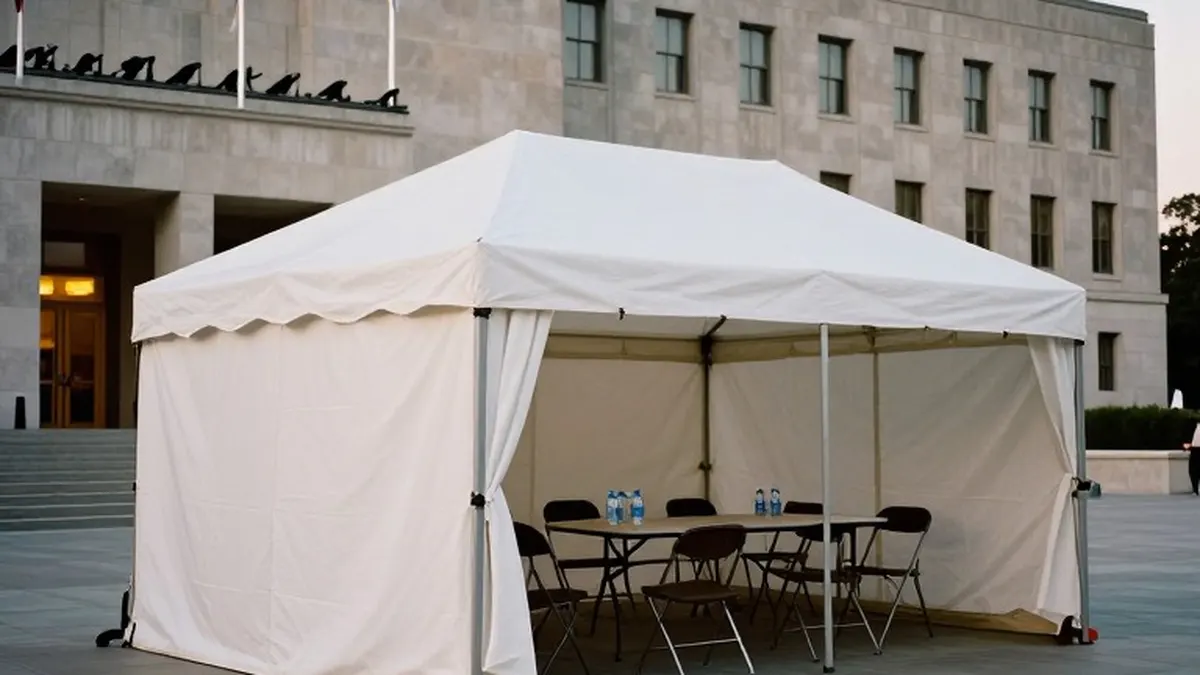
B'Yachad party leader Naftali Bennett voiced confidence on Tuesday that Israel's rival political camps can reach agreement on a unity government, saying he was "very optimistic" during a visit to a protest tent set up outside the Knesset.
"I am very optimistic. I will not elaborate in this forum. There is not much time, and we need to establish a good, Zionist government and simply get to work," Bennett said. He added: "I believe that if we can fight together in Gaza, we can work together in this building."
The so-called unity tent was erected directly outside the Knesset on Saturday night by Elisha Medan, a Likud MK and IDF veteran who lost both his legs in an explosion in northern Gaza during the Israel-Hamas war. Medan has pledged to remain at the site day and night to press the parties to form a unity government, and Gadi Eisenkot and other members of his bloc have visited in recent days. Bennett came on Tuesday together with fellow party members MK Yonatan Shalev and MK Michal Negri.
Bennett has yet to state publicly where he stands on a unity government or on the makeup of a coalition. According to a Channel 12 report, however, he has been urging party leaders in the bloc led by Yashar chief Eisenkot to seriously consider the option, and he has backed Eisenkot serving first as prime minister in a rotation arrangement with Prime Minister Benjamin Netanyahu.
Netanyahu has repeatedly called for a unity government after his bloc lost its parliamentary majority to Eisenkot's bloc in the October 27 elections. Representatives of Yashar and Likud met on Sunday for preliminary talks on the possibility, and a representative of Bennett's B'Yachad also attended that meeting.
Not all parties in the Eisenkot-led bloc support the idea. MK Yair Golan of the Democrats and MK Avigdor Liberman of Yisrael Beytenu both rejected a unity government with Netanyahu on Monday. B'Yachad later announced that Bennett would hold a series of meetings on Tuesday afternoon with Eisenkot, Liberman and Golan.
Speaking at a faction press conference at the Knesset on Monday, Golan warned that leaving Netanyahu in power would endanger Israel, and he urged Eisenkot not to repeat the experience of former alternate prime minister Benny Gantz, who joined two unity governments with Netanyahu under agreements that were never honored, including one that would have made Gantz prime minister. "Gadi, I call on you to remember the lessons of Benny Gantz. Netanyahu broke promises and trampled on agreements," Golan said. "Anyone who places power in his hands again is endangering Israel's future."
While Golan has called for forming a government with the support of the Arab parties, Liberman has drawn a red line against that option. Liberman said the Eisenkot-led bloc would instead reach an agreement with the haredi, or ultra-Orthodox, parties to form a government, and that a conscription law would still pass. He urged the parties to "find the right formula" acceptable to the haredi parties and to IDF Chief of Staff Lt.-Gen. Eyal Zamir, and to submit it to the High Court of Justice for review, while acknowledging it would not require everyone to enlist.
Party leaders in the Eisenkot-led bloc have recently opened the door to coalition negotiations with the haredi parties after previously ruling out such a partnership, offering an alternative path out of the deadlock that followed the elections. The haredi parties have been key partners in Netanyahu's coalition, making it unclear whether they would agree to join a government led by Eisenkot. Eisenkot, for his part, has drawn a red line against serving in a Netanyahu-led government and has laid out four key principles that MKs must accept to join his coalition.