China to Fly Pakistani Pilot on Shenzhou 24
Muhammad Zeeshan Ali will become the first foreigner to visit the Tiangong station, launching alongside two Chinese astronauts this week.
By Aiko Petrov ·
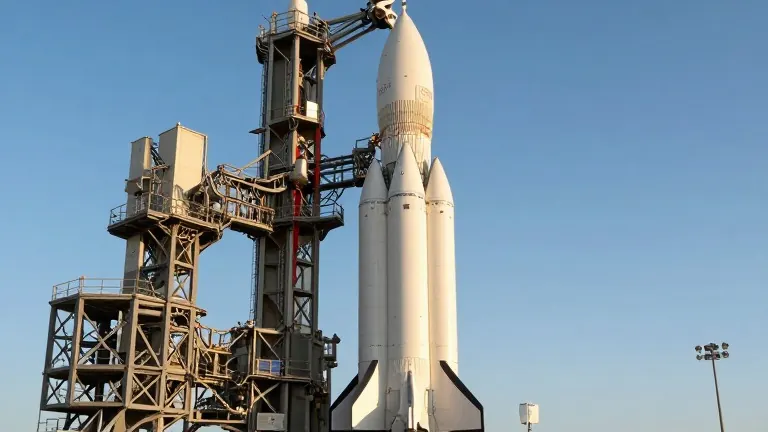
The conflict over who leads next steps in space exploration just shifted as China confirmed its first joint crew with a foreign partner. The Shenzhou 24 mission, launching from the Jiuquan Satellite Launch Center in northwest China on Wednesday, will include Muhammad Zeeshan Ali, a 40-year-old former air force pilot from Pakistan. He will be the first non-Chinese astronaut to board the Tiangong space station.
This milestone stems from an agreement signed between Beijing and Islamabad in February 2025. Prior to this launch, all missions under the China Manned Space Agency were exclusively staffed by Chinese nationals. The inclusion of Ali marks a concrete move toward international cooperation in low Earth orbit, distinct from the bilateral efforts seen in the International Space Station.
The crew consists of three members. Alongside Ali, the team includes Tang Hongbo, 51, and Wu Yi, 39. Tang Hongbo is a veteran of two previous spaceflights. This mission will make him the first person to board the Tiangong station three times. Wu Yi will make his debut in space.
CCTV stated that Ali will serve as a payload specialist for a short-term mission. His primary duties involve daily operations and four specific scientific projects focused on biotechnology and materials. He will also conduct an experiment on photosynthetic microorganisms while in orbit. Unlike his Chinese counterparts, who will remain on the station for a longer duration, Ali is scheduled to return to Earth aboard the Shenzhou 23 spacecraft.
At a press conference, the astronauts discussed the challenges of working across cultural and linguistic lines. Tang Hongbo noted that the spacecraft and station labels are in Chinese, while Ali had little prior foundation in the language. To bridge the gap, Ali and his colleagues increased their study of English and Mandarin. Ali expressed that the mission is a starting point for deeper collaboration, hoping for future joint flights to the Moon and Mars.
China is currently preparing for its first crewed lunar landing by 2030. This timeline places it in direct competition with the United States, where NASA targets a lunar return in 2028. The launch of Shenzhou 24 this week serves as a practical test of China’s ability to integrate foreign personnel into its operational space infrastructure before those lunar efforts begin.