Boccia Career Fills Every Gallery Room
Over thirty paintings from a 90-year career occupy the entire space at Philip Slein Gallery in St. Louis.
By Lorenzo Marshall ·
Philip Slein Gallery opened its doors on October 23 for a reception that marks the start of a full-space exhibition. The show, titled Edward E. Boccia: An American Modernist, runs through December 19. It is the first time in the gallery's 23-year history that the entire floor has been dedicated to a single artist.
The gallery at 4735 McPherson Avenue usually reserves its back rooms for group shows. For this survey, owner Philip Slein filled every available wall with work from Boccia, who lived in St. Louis for six decades. Slein called the presentation the largest individual show the gallery has hosted, noting that only an institutional venue could mount something larger.
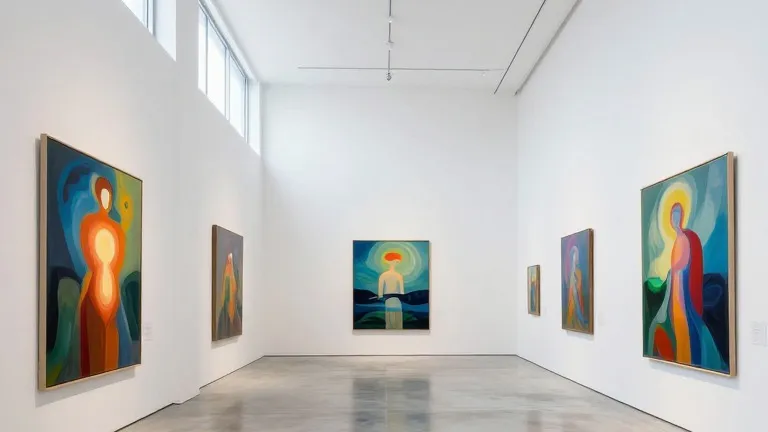
The exhibition includes more than 30 paintings that trace Boccia's career from the 1950s to 2012. The front room displays large-scale works, such as the nine-panel polyptych Eugene's Journey. A hallway features mythic ocean scenes with figures that appear to glow from within. The final room uses a salon wall to show his evolution from a 1950s portrait to a painting made shortly before his death in 2012.
Boccia was born in New Jersey in 1921 to Italian parents. He served in the World War II Ghost Army before studying at the Pratt Institute, the Art Students League, and Columbia University. He taught at the Columbus Art School in Ohio, where he introduced Bauhaus concepts to his students. He joined Washington University in St. Louis in 1951 and retired in 1986 as professor emeritus.
Art historian Rosa Berland, who is based in New York, curated the show. She described Boccia's teaching style as rigorous but encouraging of individual expression. Berland has spent 14 years researching the artist and is the author of the first major monograph on his work. The book, Edward E. Boccia: Painter of Nightmares and Dreams, will be published by Hirmer during the exhibition.
Boccia produced thousands of paintings, ranging from small seaside scenes to monumental multi-panel works. His style blends classical traditions with experimental surrealism. Slein said Boccia worked constantly, adding that if he was not sleeping or eating, he was drawing. Boccia died in 2012 at age 91.
The show includes works that reference Paul Cézanne, Pablo Picasso, René Magritte, and Max Beckmann. Berland credited Morton D. May as Boccia's greatest patron. She described Boccia as a polymath who studied philosophy, theology, and psychoanalysis. A pamphlet for the show includes his advice to viewers: Do not worry about what my art means. Just experience it.
Source: St. Louis Magazine
More Culture · St. Louis news · Report a business · Got a Story?