Avian Cognition: Crows Outpace Primates in Decision Speed
A new study reveals that crows use the same neural logic as monkeys for decision making, but process the information at twice the speed.
By Amy Swan ·
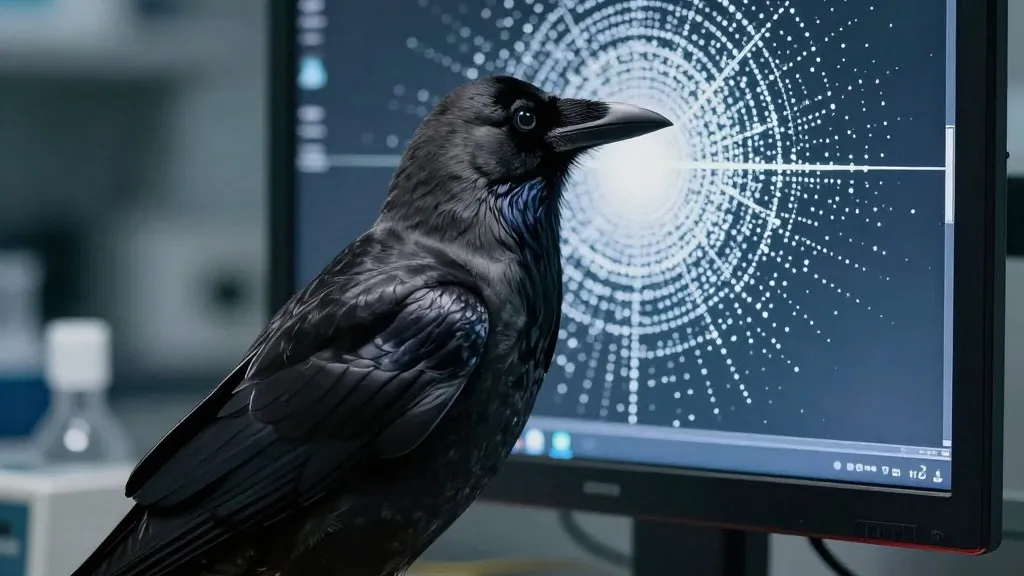
The long-standing assumption that complex decision making requires a neocortex is under pressure. While decades of primate research have mapped how human-like brains weigh evidence, the mechanisms in bird brains remained a mystery. A recent study published today challenges the notion that different brain structures necessitate different cognitive strategies. It suggests that crows not only solve complex visual tasks using the same mathematical logic as primates, but they do so with significantly greater speed.
The core of the investigation relies on a well-established experimental paradigm known as the random-dot-motion task. In this test, a cloud of flickering specks drifts weakly in a single direction, forcing the subject to determine if there is motion and identify its vector. Previous work with monkeys demonstrated that neurons in the neocortex accumulate visual evidence over time. Their firing rates gradually increase until they cross a specific threshold, triggering a committed choice. This threshold-based model has become a cornerstone of modern neuroscience, yet its applicability to birds, which lack a neocortex entirely, remained an open question.
Andreas Nieder, a neurobiologist at the University of Tübingen, identified this gap as the primary driver for the new research. He noted that the fundamental question was how a differently organized avian brain would encode decisions without the standard primate architecture. To address this, Nieder and colleague Philipp Schmidbauer designed an experiment that mirrored primate protocols as closely as possible. The goal was to isolate cognitive logic from species-specific brain anatomy, ensuring that any differences in performance could be attributed to structural variations rather than methodological inconsistencies.
Two hand-raised carrion crows were placed in front of a touch-sensitive monitor displaying white dots against a black background. The birds were required to report the direction of movement by pecking one of two targets flanking the display. A correct choice resulted in a mealworm reward, while incorrect choices yielded nothing. The setup was deliberately identical to the monkey version, with the sole modification being the response mechanism. Crows used pecks to indicate their decisions, whereas monkeys typically use eye movements, a distinction that Nieder emphasized was critical for maintaining experimental parity.
To test the limits of the birds' cognitive processing, the researchers varied the difficulty of the task by adjusting the coherence of the dot motion. At the easiest level, 81 percent of the dots moved in a unified direction, making the answer trivially apparent. At the most challenging level, only 3 percent of the dots moved coherently, rendering the signal barely distinguishable from random noise. The team also included a control condition with 0 percent coherence, where no correct answer existed, to measure the birds' tendency to guess when evidence was absent.
The results confirmed that crows employ the same decision-making logic as primates. Despite the absence of a neocortex, the birds accumulated evidence over time and crossed a threshold to commit to a choice, mirroring the mathematical processes observed in monkeys. However, the most striking finding was the speed of this process. The crows reached their decisions twice as fast as the primate subjects. This speed advantage suggests that the avian brain architecture is not just a functional equivalent but a more efficient processor for this specific type of visual integration.
This discovery carries significant implications for our understanding of neural efficiency. It demonstrates that a brain without a neocortex can arrive at complex decisions through a comparable process, challenging the view that the neocortex is the exclusive engine of higher-order cognition. The findings suggest that evolutionary pressure has optimized avian brains for rapid decision making, a trait that may be essential for survival in flight. As researchers continue to probe the boundaries of animal cognition, the crow emerges not just as a clever bird, but as a faster, leaner model of the decision-making process.
The study provides a clear benchmark for future cross-species comparisons. By establishing that the underlying logic is conserved, scientists can now focus on the specific neural substrates that drive the speed difference. The work opens the door to exploring how other non-primates might handle similar cognitive tasks. For now, the crow has outpaced the monkey, offering a glimpse into a different, and perhaps superior, approach to processing the world's visual chaos.
Source: Ars Technica