Survey Finds 54% of Liberal College Students Support Violence Against Hate Speech
New data from the Buckley Institute shows a disconnect between student views on free speech and First Amendment protections, with the University of Utah receiving a low grade in recent rankings.
By Harper Foster ·
The Buckley Institute’s 2026 National Undergraduate Student Survey reveals that nearly half of American college students believe physical violence is a justified response to hate speech. The online survey was conducted from September 5 to September 14 and included 803 undergraduate students under the age of 25 attending four-year programs. This marks the twelfth year the institute has tracked these attitudes among undergraduates.
Support for using force varied by political affiliation. Among liberal students, 54% agreed that violence could be justified to stop hate speech. Conservative students showed lower support, with 30% agreeing with the statement. A notable finding is that 72% of students who support violence also acknowledge that hate speech is protected by the First Amendment. This suggests a gap between legal understanding and emotional reaction to offensive ideas.
Paul Cassell, a law professor at the University of Utah, noted that the Supreme Court has long held that speech does not lose constitutional protection just because some view it as deeply offensive. He cited the assassination of Charlie Kirk as the ultimate threat to free speech, stating that no one should live in fear of being harmed for expressing controversial ideas. The survey was released around the one-year anniversary of Kirk’s death.
Beyond the use of violence, the survey found that 42% of students believe hearing opinions they disagree with can harm their mental health. Sean Stevens, chief researcher at the Foundation for Individual Rights and Expression, observed that students are most afraid of their peers. Stevens said students fear repercussions from classmates more than from professors or administrators.
Perceptions of higher education are shifting in the broader public. A Gallup report published on October 1 showed a record low in the percentage of Americans who believe college is important. Thirty-one percent said college was very important, while nearly three in 10 said it was not too important. Stevens pointed to campus free speech, political perceptions, and the return on investment of a degree as factors contributing to this decline.
The University of Utah has faced scrutiny in this debate. The Foundation for Individual Rights and Expression ranked the university 131st out of 261 institutions in its 2027 College Free Speech Rankings, giving it a D-minus grade. Rylie Barnes, vice president of the University of Utah College Republicans, said the university claims to welcome free speech, but actions suggest otherwise. She reported that conservative students have faced threats and were kicked out of class for expressing their views.
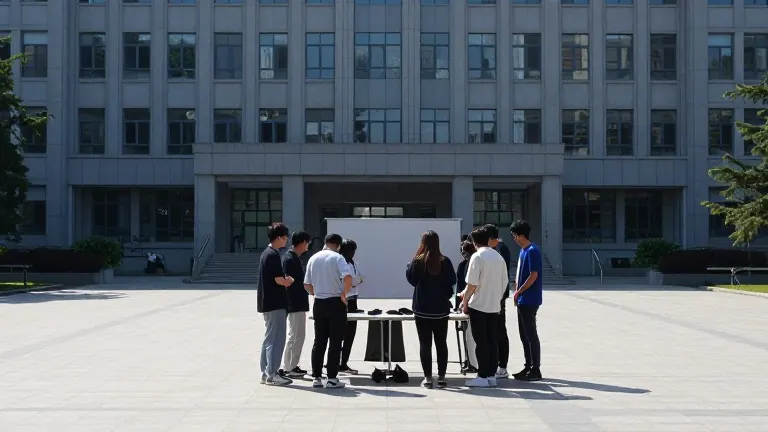
Barnes described an incident on October 27 during a College Republicans tabling event. A student erased a whiteboard that stated there are only two genders. When a club member confronted the student, Barnes said the student lunged, attacked him, and ripped his shirt. The university stated that police identified the individual and issued two Class B misdemeanor citations for simple assault and property damage.
Not all students share this experience. Ian Jacobsen, external communications director for the College Democrats at the University of Utah, said he feels comfortable expressing his views. Jacobsen criticized the College Republicans for using provocative messages to entice arguments, calling their social media posts deliberately inflammatory. He maintained that violence is never an appropriate response to disagreement.
Sean Stevens suggested nonviolent alternatives for expressing disapproval, such as protesting outside events, holding signs, or turning one’s back on a speaker. Lauren Noble, executive director of the Buckley Institute, urged universities to collect and publicly release data on the free speech climate on their campuses. Both experts pointed to the University of Chicago’s Report of the Committee on Freedom of Expression as a model for protecting open debate.
Daylan Alzamora, president of the College Republicans at the University of Utah, recalled a recent debate with the College Democrats. He said the event avoided hot-button issues in favor of policy-oriented discussion. Alzamora told his members to remember that they are there to open minds as much as others are there to open theirs. Noble emphasized that universities must stand by free speech principles even when they are challenging and regularly educate students on their value.