NASA's Voyager 1 Becomes First Human Object to Reach One Light-Day
The spacecraft, launched in 1977, is now over 16 billion miles from Earth, marking a new milestone in deep space exploration.
By Lorenzo Marshall ·
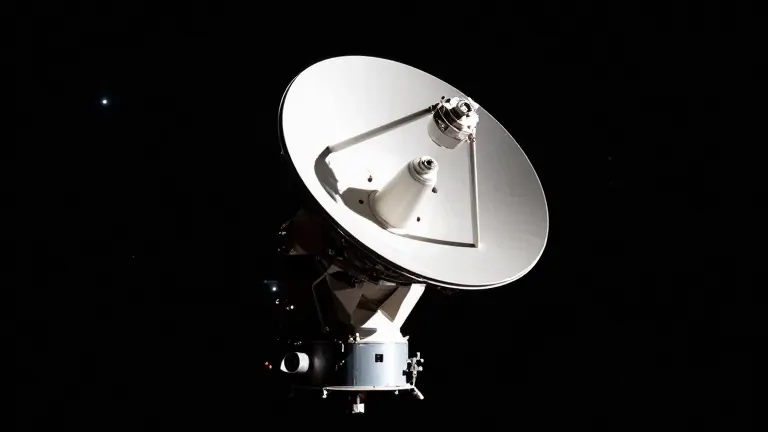
NASA’s Voyager 1 became the first object built by humans to reach a distance of one light-day from Earth on Wednesday. The spacecraft is now more than 16 billion miles away, a distance that requires radio signals exactly 24 hours to travel back to the planet at the speed of light.
This milestone places the probe deeper into interstellar space, the region between star systems. NASA calculates that it will take the spacecraft another 18,000 years to cover a full light-year. It will require more than twice that duration before the probe approaches another star.
Voyager 1 launched in 1977, two weeks before its twin, Voyager 2. Despite its age, the probe continues to transmit scientific and engineering data while traveling at 38,000 mph. Voyager 2 will not reach the one light-day mark until 2035.
Suzanne Dodd, the project director, described the craft as an ambassador for Earth moving among the stars. She told The Associated Press that the mission offers a sense of wonder and serves as a national treasure.
The spacecraft has faced sporadic issues related to its age. In September, engineers completed efforts to conserve the power of the plutonium-fueled probe. In October, contact was briefly lost, and the team is still investigating the cause of the interruption.
A small flight control team at NASA’s Jet Propulsion Laboratory in Pasadena, California, sends commands to the spacecraft approximately once a week. The operation intensifies when problems arise, and the team sometimes receives assistance from retired former project members.
Voyager 1 flew past Jupiter in 1979 and Saturn in 1980 before exiting the solar system in 2012. It now sends daily data on magnetic field intensity, direction, pressure, dust, and galactic cosmic rays. Dodd, who has worked with the probes since 1984, compares them to weather satellites operating in an unexplored environment.
The mission has already set records for the most distant human-made object and the farthest photograph of Earth. In 1990, Voyager 1 captured the Pale Blue Dot image from beyond Neptune. Astronomer Carl Sagan, who was part of the imaging team, said the image showed a small stage in a vast cosmic arena where every human has lived.
Bill Nye of the Planetary Society stated that everyone on Earth has been touched by these missions. The Planetary Society was co-founded by Sagan in 1980. Each Voyager carries a gold-plated phonograph record containing greetings in 55 languages, images, and diagrams. Sagan included the voice of his six-year-old son, Nick, saying hello from the children of planet Earth. Dodd called the record a time capsule of life on Earth in 1977, hoping someone might find it in 1,000 years.