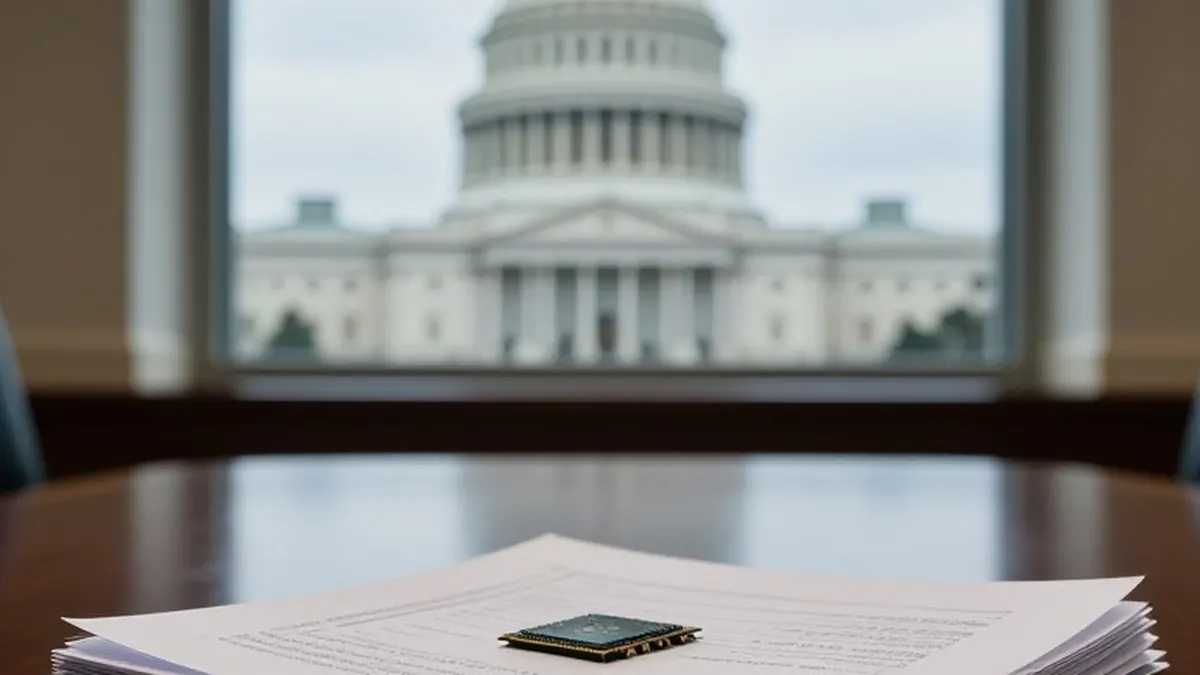
Report reveals PLA actively seeking Nvidia chips for AI military systems
A congressional commission states that China's military is bypassing export controls to acquire advanced American semiconductors, citing a significant gap in domestic chip production capabilities.
By Lorenzo Marshall ·

A report released on Wednesday by the U.S.-China Economic and Security Review Commission indicates that China's People's Liberation Army has been actively soliciting Nvidia's most advanced semiconductor chips. The objective is to develop artificial intelligence-enabled military capabilities. This finding arrives during a period of significant turmoil for Nvidia, which has been rocked by the resignation of CEO Jensen Huang. Reports suggest Huang had an affair with a suspected Chinese spy who worked for Megaspeed, a Singapore-based firm currently under investigation by U.S. authorities for potentially diverting Nvidia chips to China.
The commission's 2026 annual report to Congress states that China is attempting to evade U.S. export controls to secure the most advanced semiconductors. These chips are essential to Beijing's drive for intelligentization. The report notes that China is making these efforts while facing a distinct quality gap between chips produced by domestic companies and those manufactured by leading U.S. firms. Chinese manufacturers such as Huawei and Cambricon are cited as being behind Nvidia and Advanced Micro Devices in terms of chip advancement.
These findings are likely to intensify concerns that advanced Nvidia chips have reached Chinese users despite ongoing investigations by Congress and various state and federal regulators. The commission emphasized that while China has made some progress toward its technological goals, it has not yet closed the hardest chokepoints. These remaining gaps include the most advanced capabilities in logic fabrication, memory, and semiconductor manufacturing equipment.
Additionally, the report highlights the persistent challenge of the Nvidia Compute Unified Device Architecture, or CUDA, which serves as a significant software moat for the company. The commission noted that China is unlikely to overcome this specific advantage for some time. Consequently, the resulting gap in compute power remains substantial, a situation the report attributes largely to U.S. export controls on advanced chips.
The report also highlighted that Chinese companies have obtained remote access to Nvidia chips through data centers located in third countries, with Malaysia being specifically mentioned. In response to this workaround, the Commerce Department's Bureau of Industry and Security issued a new rule on Tuesday. The regulation is intended to cut off this method of access, thereby tightening the net around advanced semiconductor distribution.
This regulatory move follows criticism from Treasury Secretary Scott Bessent and members of Congress. They argued that the Commerce Department had not done enough to prevent Nvidia's most advanced chips from being diverted to China in violation of existing U.S. export controls. The new rule aims to address these oversight concerns and strengthen the enforcement mechanisms in place.
The U.S.-China Economic and Security Review Commission was created by Congress in 2000. Its primary mandate is to monitor and report to Congress on the national security implications of the trade and economic relationship between the United States and China. The latest report underscores the continuing strategic importance of semiconductor technology in this bilateral dynamic.
As investigations continue, the interplay between corporate leadership changes, geopolitical strategy, and regulatory enforcement remains a focal point for policymakers. The resignation of Jensen Huang and the scrutiny of Megaspeed add layers of complexity to an already intricate situation involving the flow of advanced technology between the two economic giants.
The commission's analysis suggests that the race to close the technological divide is ongoing. While U.S. controls have created a substantial compute gap, the efforts by the Chinese military to secure Nvidia chips demonstrate the high value placed on these specific components. The coming months will likely see further developments as regulators and legislators work to refine their strategies.
More News · National news · Report a business · Got a Story?