Bahrain Defense: Iran Launches Third Strike on U.S. Radar Site
Drone attacks resume after a two-month pause, prompting Gulf states to condemn the violation of sovereignty while U.S. forces report no casualties.
By Lorenzo Marshall ·
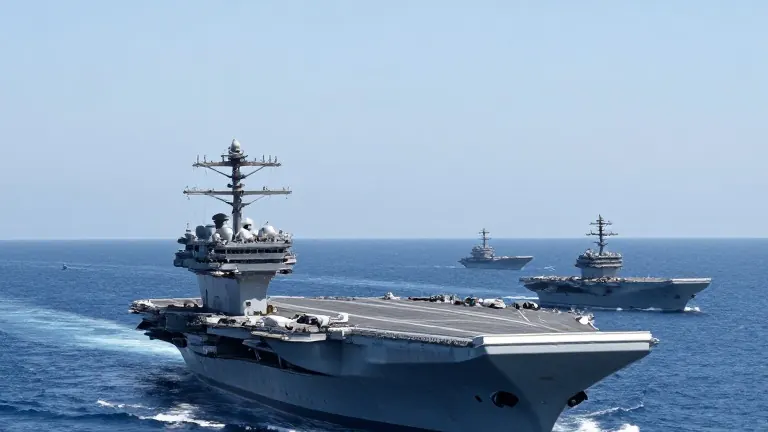
The U.S. military has deployed three aircraft carrier strike groups to the Middle East, a force level that exceeds the assets present when the war began on Feb. 28. The buildup arrives as Iranian drones struck a U.S. radar facility in Bahrain on Tuesday. This marks the third Iranian attack on American military targets in the Persian Gulf island kingdom in recent days. The strikes ended a roughly two-month lull in fighting.
Bahrain announced that its air defense systems intercepted the incoming Iranian aerial attacks. The country described the fire as treacherous. The U.S. military confirmed there was no damage to American equipment and no injuries to U.S. personnel. The targeted site is an early warning radar facility. Iran also fired at a radar system at an American helicopter base in Bahrain on Sunday.
Iran stated it was retaliating for U.S. strikes on Iranian communications towers and ongoing drone surveillance operations. The Revolutionary Guard Corps said continued aggression against Iran's airspace and the use of regional bases for hostile acts would not go unanswered. The attacks follow a period in which Iran waited for U.S. action before striking to degrade the operational capability of bases, according to Mostafa Najafi, a Tehran-based security analyst.
Regional leaders reacted quickly to the latest volley. Egypt, Qatar, Saudi Arabia, and the United Arab Emirates condemned the attack on Bahrain. The Gulf states called the drone strikes a violation of Bahrain's sovereignty and a threat to regional security. Qatar warned that the continued attacks undermine diplomatic efforts to end the war.
Hamidreza Azizi, a senior Iran analyst at the International Crisis Group, noted that the risk of renewed war now depends on Tehran's assessment of costs. He wrote that Iranian leaders are weighing whether breaking the blockade through escalation is less costly than accepting its continuation. Azizi said the risk depends on whether Tehran concludes the costs of restraint are greater than the risks of escalation.
President Donald Trump has described new strikes as highly unlikely, yet he has ordered the deployment of the USS Theodore Roosevelt carrier strike group. The Roosevelt joins the USS George H.W. Bush and the USS George Washington in the region. U.S. Central Command has not confirmed if it will keep all three carrier groups deployed. The expanded naval presence provides greater offensive firepower and missile interception capacity, according to an analysis by Israel's Institute for National Security Studies.
The naval blockade enforced by the U.S. in the Strait of Hormuz is damaging Iran's economy by limiting the flow of crude oil to global markets. Oil tankers moving through the strait under U.S. protection have helped return Gulf oil shipments to roughly prewar levels. Iran and its proxies continue to disrupt shipping in the area.
The U.S. Navy's 5th Fleet is based in Bahrain and has sustained damage in previous Iranian attacks since Feb. 28. Negotiations to end the war have stagnated despite mediation efforts by Qatar. Iranian officials describe the current situation as no war, no peace, and have vowed to end it while signaling readiness to escalate against tightening sanctions.